Could pet Ozempic drugs help your pet lose weight?

Instead of weekly injections like the human recipients of the blockbuster weight loss pharmaceuticals receive, the felines take capsules under the skin that last for six months.
The drugs now helping some 21.4 million Americans resist the siren song of fattening food may also start doing the same for our four-legged friends — and a Florida veterinary professor is leading the study.
Dr. Chen Gilor, a veterinarian at the University of Florida, told the New York Times that he’s heading up a study of GLP-1 drugs involving 50 obese cats. Instead of weekly injections like the human recipients of the blockbuster weight loss pharmaceuticals receive, the felines are getting under-the-skin capsules that last six months.
“You insert that capsule under the skin, and then you come back six months later, and the cat has lost the weight,” Gilor told the Times. “It’s like magic.”
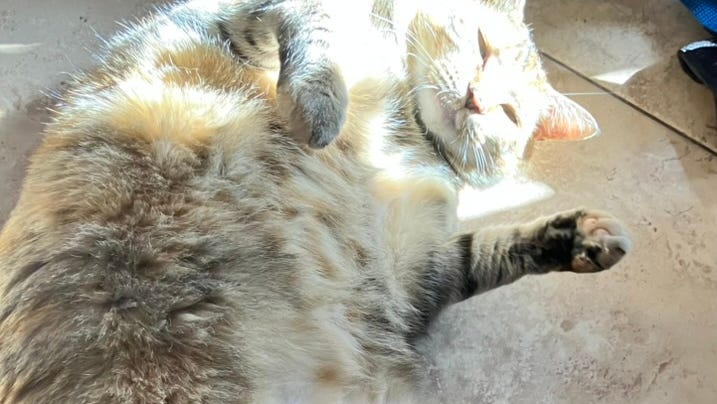

Pet Ozempic? Yep, Time to Tame Your Fat Cat
GLP 1 drugs used for weight loss in people are now being tested for pets. A UF vet says it could turn your fat cat skinny like magic
Its success — and study results are expected later this year — could lead the way to a kind of pet Ozempic, the name of the most popular brand in this drug class. GLP-1 drugs appear to work in pets the same way they work in humans, according to industry reports.
The active ingredient mimics a natural hormone that activates receptors that increase insulin production, which slows stomach emptying and reduces appetite.
What do people experience on GLP-1 drugs?
Nancy Dominguez, managing director of the Florida Association of Public Insurance Adjusters, has been taking an Ozempic prescription for a year.
Like many who go on the GLP-1 drugs, which are also on the market under the names Wegovy, Zepbound and Trulicity, she’s found it’s a game-changer.
After years of dieting without any results, Dominguez has been able to drop 30 pounds and her blood sugar numbers have improved markedly over the past year, she said.
“It’s the best thing that’s ever happened to me,” said Dominguez, 60, who lives in the Miami area.”
She said she’s been struggling with her weight for the past 30 years. And, even though her weight was at 275 on her 5-foot, 61/2-inch frame, she remembers being so hungry it was “like panic.”
“It didn’t matter what I ate, I was just feeling like, I’ve got to put something in myself because I’m so hungry,” she recalled of her pre-GLP-1 life.
Dominguez said she’s still taking insulin to help manage her Type 2 diabetes — a complication of obesity — but she’s anticipating that soon she’ll be able to drop the daily shots.
Those are the same shots that an estimated 1 in 400 U.S. cats get because of their diabetes, which is like the Type 2 diabetes that afflicts millions of Americans.
How prevalent is pet obesity?
About 59% of dogs and 61% of cats meet the definition of obese — an increasing number, according to a 2022 survey by the Association for Pet Obesity Prevention.
That’s even worse than the numbers that the National Center for Health Statistics report for adult Americans — with 40% tipping the scales that way.
Like humans, excess weight puts a pet at greater risk for a host of conditions: arthritis, stressed joints, heart disease, high blood pressure, cancer and diabetes.
Also like humans, the excess weight shortens lifespans. But there could be a pharmaceutical solution for both cats and dogs, more than one drug company believes, the Times reports.

“Real Housewives” star Heather Gay shares weight loss success story
Heather Gay shares her lifelong battle with weight and how her GLP-1 journey helped her feel empowered.
What do Florida veterinarians think of the weight control for drugs?
Dr. Mary Ellen Scully, owner and veterinarian at Island Animal Hospital on Palm Beach, doesn’t have to be convinced that pet weight loss drugs work — she was part of a demonstration of them for the TV cameras during the last generation of weight control prescriptions for pets. A fat Labrador was in the demonstration, along with an overweight Cavalier King Charles Spaniel, she recalled.
“The drug actually did work for making them lose weight,” Scully said. “But the thing about it is, if your dog is overweight, it is ultimately the human’s responsibility, because they’re putting the food in the bowl.”
Unlike the national statistics from the Association for Pet Obesity Prevention, Scully said she’s seen more awareness among her patients’ humans that love is best expressed to a pet with healthier food in moderate quantities, instead of generous treats.
“I could be a great weight if I had somebody falling around and swatting cookies out of my hands,” Scully joked.
Dr. Kalissa Grabowski, who spent part of her career in a practice dedicated to cats, where most of the clientele was not interested in taking a walk for exercise, also believes in educating pet parents about the right food in the right amount. But she is all for more options to address unique situations.
Multiple cats in one household can be challenging even for veterinarians, she noted.
“I had one overweight cat and one little one and so I finally started figuring out the one kitty cat was eating two breakfasts,” said Grabowski, now chief of staff at Pet Vet Animal Hospital in Deerfield Beach.
She tried monitoring the situation more closely, but it was easy to get distracted.
“That can be a little more labor intensive,” she said of trying to police the intake of multiple cats.
What are smart pet food bowls and do they help with weight loss?
Smart pet food bowls that came on the market about 10 years ago can also help. Using one of those, a chip in the cat collar, identifies the amount that should be dispensed for each cat in the household, Grabowski said.
“Maybe these drugs and these discussions are going to help pet owners feel more successful, because I think some of them are not at fault, but at a loss, and they need some guidance and ideas,” she said. “And the more clever we can be …”
Umberto Calvo, who trains dogs in Clewiston at Lake’s Guardian, expects he’s going to have to get much cleverer if he gets a four-legged client who is less interested in food rewards because the dog already feels full.
“Food drive is a very important part of dog training,” Calvo said.
Toys motivate a few select breeds, he said, but a dog’s lack of food motivation makes training a lot more difficult.
“You can always do it, but it takes a lot longer and the results are never the same,” he said.
Anne Geggis is statewide reporter for the USA TODAY NETWORK FLORIDA, reporting on health and senior issues. If you have news tips, please send them to [email protected]. You can get all of Florida’s best content directly in your inbox each weekday by signing up for the free newsletter, Florida TODAY, at
link

:max_bytes(150000):strip_icc()/cat-anesthesia-and-sedation-515690575-2000-52fb0a1ed6c544e79028db04b664a1ce.jpg "Uses, Safety, and Side Effects")