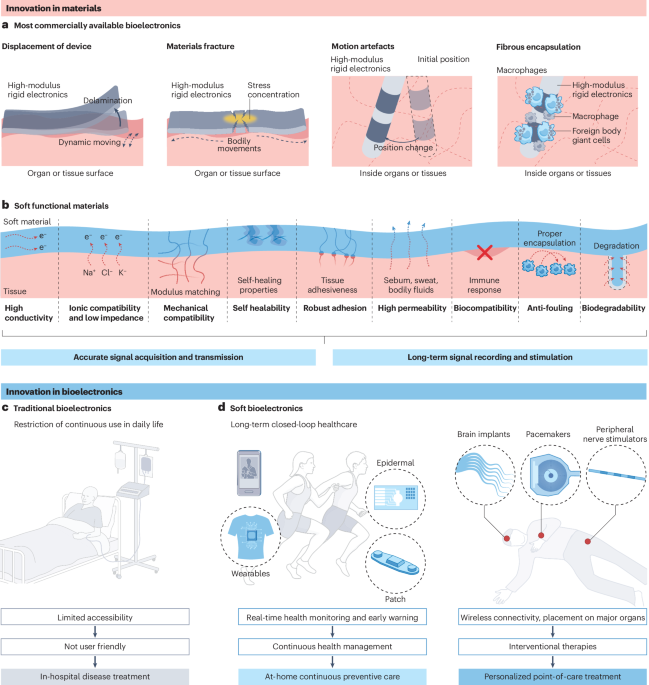
Materials design and integration strategies for soft bioelectronics in digital healthcare
Park, S., Garcia-Palacios, J., Cohen, A. & Varga, Z. From treatment to prevention: the evolution of digital healthcare. Nature 573, 7775 (2019).
Chen, C., Ding, S. & Wang, J. Digital health for aging populations. Nat. Med. 29, 1623–1630 (2023).
Google Scholar
Chapman, R. & Middleton, J. The NHS long term plan and public health. BMJ 364, l218 (2019).
Google Scholar
Sunwoo, S.-H., Ha, K.-H., Lee, S., Lu, N. & Kim, D.-H. Wearable and implantable soft bioelectronics: device designs and material strategies. Annu. Rev. Chem. Biomol. 12, 359–391 (2021).
Google Scholar
Cho, K. W. et al. Soft bioelectronics based on nanomaterials. Chem. Rev. 122, 5068–5143 (2022).
Google Scholar
Feiner, R. & Dvir, T. Tissue–electronics interfaces: from implantable devices to engineered tissues. Nat. Rev. Mater. 3, 17076 (2018).
Google Scholar
Zhao, C., Park, J., Root, S. E. & Bao, Z. Skin-inspired soft bioelectronic materials, devices and systems. Nat. Rev. Bioeng. 2, 671–690 (2024).
Google Scholar
Yuk, H., Wu, J. & Zhao, X. Hydrogel interfaces for merging humans and machines. Nat. Rev. Mater. 7, 935–952 (2022).
Google Scholar
Kim, J. et al. Skin-interfaced wireless biosensors for perinatal and paediatric health. Nat. Rev. Bioeng. 1, 631–647 (2023).
Google Scholar
Lin, M., Hu, H., Zhou, S. & Xu, S. Soft wearable devices for deep-tissue sensing. Nat. Rev. Mater. 7, 850–869 (2022).
Google Scholar
Koo, J. H. et al. Electronic skin: opportunities and challenges in convergence with machine learning. Annu. Rev. Biomed. Eng. 26, 331–355 (2024).
Google Scholar
Xu, C., Solomon, S. A. & Gao, W. Artificial intelligence-powered electronic skin. Nat. Mach. Intell. 5, 1344–1355 (2023).
Google Scholar
Luo, Y. et al. Technology roadmap for flexible sensors. ACS Nano 17, 5211–5295 (2023).
Google Scholar
Walter, J. R., Xu, S. & Rogers, J. A. From lab to life: how wearable devices can improve health equity. Nat. Commun. 15, 123 (2024).
Google Scholar
Davis, N., Heikenfeld, J., Milla, C. & Javey, A. The challenges and promise of sweat sensing. Nat. Biotechnol. 42, 860–871 (2024).
Google Scholar
Tang, X., Shen, H., Zhao, S., Li, N. & Liu, J. Flexible brain–computer interfaces. Nat. Electron. 6, 109–118 (2023).
Google Scholar
Sunwoo, S.-H. et al. Soft bioelectronics for the management of cardiovascular diseases. Nat. Rev. Bioeng. 2, 8–24 (2024).
Google Scholar
Dong, C. et al. Electrochemically actuated microelectrodes for minimally invasive peripheral nerve interfaces. Nat. Mater. 23, 969–976 (2024).
Google Scholar
Jiang, H. et al. Finite deformation mechanics in buckled thin films on compliant supports. Proc. Natl Acad. Sci. USA 104, 15607–15612 (2007).
Google Scholar
Sun, Y., Choi, W. M., Jiang, H., Huang, Y. Y. & Rogers, J. A. Controlled buckling of semiconductor nanoribbons for stretchable electronics. Nat. Nanotechnol. 1, 201–207 (2006).
Google Scholar
Kim, D.-H. et al. Epidermal electronics. Science 333, 838–843 (2011).
Google Scholar
Liu, J. et al. Syringe injectable electronics. Nat. Nanotechnol. 10, 629–636 (2015).
Google Scholar
Wang, Z. et al. Kirigami-patterned highly stretchable conductors from flexible carbon nanotube-embedded polymer films. J. Mater. Chem. C 5, 8714–8722 (2017).
Google Scholar
Blees, M. K. et al. Graphene kirigami. Nature 524, 204–207 (2015).
Google Scholar
Matsuhisa, N., Chen, X., Bao, Z. & Someya, T. Materials and structural designs of stretchable conductors. Chem. Soc. Rev. 48, 2946–2966 (2019).
Google Scholar
Han, M. et al. Three-dimensional piezoelectric polymer microsystems for vibrational energy harvesting, robotic interfaces and biomedical implants. Nat. Electron. 2, 26–35 (2019).
Google Scholar
Zhang, L. et al. 3D morphable systems via deterministic microfolding for vibrational sensing, robotic implants, and reconfigurable telecommunication. Sci. Adv. 8, eade0838 (2022).
Google Scholar
Zhang, L. et al. Skin-inspired, sensory robots for electronic implants. Nat. Commun. 15, 4777 (2024).
Google Scholar
Kim, Y. et al. Chip-less wireless electronic skins by remote epitaxial freestanding compound semiconductors. Science 377, 859–864 (2022).
Google Scholar
Liu, Z. et al. A three-dimensionally architected electronic skin mimicking human mechanosensation. Science 384, 987–994 (2024).
Google Scholar
Lacour, S. P., Wagner, S., Huang, Z. & Suo, Z. Stretchable gold conductors on elastomeric substrates. Appl. Phys. Lett. 82, 2404–2406 (2003).
Google Scholar
Minev, I. R. et al. Electronic dura mater for long-term multimodal neural interfaces. Science 347, 159–163 (2015).
Google Scholar
Park, J. et al. Electromechanical cardioplasty using a wrapped elasto-conductive epicardial mesh. Sci. Transl. Med. 8, 344ra86 (2016).
Google Scholar
Choi, S. et al. Highly conductive, stretchable and biocompatible Ag–Au core–sheath nanowire composite for wearable and implantable bioelectronics. Nat. Nanotechnol. 13, 1048–1056 (2018).
Google Scholar
Jung, D. et al. Highly conductive and elastic nanomembrane for skin electronics. Science 373, 1022–1026 (2021).
Google Scholar
Siddiqui, S. et al. A durable and stable piezoelectric nanogenerator with nanocomposite nanofibers embedded in an elastomer under high loading for a self-powered sensor system. Nano Energy 30, 434–442 (2016).
Google Scholar
Lin, Z., Li, T., Yang, S., Ji, B. & Wang, Z. Revolutionizing flexible electronics with liquid metal innovations. Device 2, 100331 (2024).
Google Scholar
Lee, W. et al. Universal assembly of liquid metal particles in polymers enables elastic printed circuit board. Science 378, 637–641 (2022).
Google Scholar
Zhou, Y. et al. Giant magnetoelastic effect in soft systems for bioelectronics. Nat. Mater. 20, 1670–1676 (2021).
Google Scholar
Kim, S. H. et al. Strain-invariant stretchable radio-frequency electronics. Nature 629, 1047–1054 (2024).
Google Scholar
Kim, D. C. et al. Intrinsically stretchable quantum dot light-emitting diodes. Nat. Electron. 7, 365–374 (2024).
Google Scholar
Xu, J. et al. Highly stretchable polymer semiconductor films through the nanoconfinement effect. Science 355, 59–64 (2017).
Google Scholar
Shim, H. et al. Elastic integrated electronics based on a stretchable n-type elastomer–semiconductor–elastomer stack. Nat. Electron. 6, 349–359 (2023).
Google Scholar
Tan, P. et al. Solution-processable, soft, self-adhesive, and conductive polymer composites for soft electronics. Nat. Commun. 13, 358 (2022).
Google Scholar
Han, W. B. et al. Ultra-stretchable and biodegradable elastomers for soft, transient electronics. Nat. Commun. 14, 2263 (2023).
Google Scholar
Ohm, Y. et al. An electrically conductive silver–polyacrylamide–alginate hydrogel composite for soft electronics. Nat. Electron. 4, 185–192 (2021).
Google Scholar
Lu, Y. et al. Stretchable graphene–hydrogel interfaces for wearable and implantable bioelectronics. Nat. Electron. 7, 51–65 (2024).
Google Scholar
Jin, S. et al. Injectable tissue prosthesis for instantaneous closed-loop rehabilitation. Nature 623, 58–65 (2023).
Google Scholar
Jiang, Y. et al. Topological supramolecular network enabled high-conductivity, stretchable organic bioelectronics. Science 375, 1411–1417 (2022).
Google Scholar
Zhou, T. et al. 3D printable high-performance conducting polymer hydrogel for all-hydrogel bioelectronic interfaces. Nat. Mater. 22, 895–902 (2023).
Google Scholar
Li, P. et al. N-type semiconducting hydrogel. Science 384, 557–563 (2024).
Google Scholar
Peng, H., Xin, Y., Xu, J., Liu, H. & Zhang, J. Ultra-stretchable hydrogels with reactive liquid metals as asymmetric force-sensors. Mater. Horiz. 6, 618–625 (2019).
Google Scholar
Jing, X., Mi, H.-Y., Peng, X.-F. & Turng, L.-S. Biocompatible, self-healing, highly stretchable polyacrylic acid/reduced graphene oxide nanocomposite hydrogel sensors via mussel-inspired chemistry. Carbon 136, 63–72 (2018).
Google Scholar
Qin, Z. et al. Carbon nanotubes/hydrophobically associated hydrogels as ultrastretchable, highly sensitive, stable strain, and pressure sensors. ACS Appl. Mater. Interfaces 12, 4944–4953 (2020).
Google Scholar
Deng, J. et al. Electrical bioadhesive interface for bioelectronics. Nat. Mater. 20, 229–236 (2021).
Google Scholar
Yang, J., Zhao, Z., Wang, S., Guo, Y. & Liu, Y. Insight into high-performance conjugated polymers for organic field-effect transistors. Chem 4, 2748–2785 (2018).
Google Scholar
Van der Zee, B., Li, Y., Wetzelaer, G.-J. A. H. & Blom, P. W. M. Efficiency of polymer light-emitting diodes: a perspective. Adv. Mater. 34, 2108887 (2022).
Google Scholar
Li, G., Zhu, R. & Yang, Y. Polymer solar cells. Nat. Photon. 6, 153–161 (2012).
Google Scholar
Fan, X. et al. PEDOT:PSS for flexible and stretchable electronics: modifications, strategies, and applications. Adv. Sci. 6, 1900813 (2019).
Google Scholar
Baker, C. O., Huang, X., Nelson, W. & Kaner, R. B. Polyaniline nanofibers: broadening applications for conducting polymers. Chem. Soc. Rev. 5, 1510–1525 (2017).
Google Scholar
Liu, Y. & Wu, F. Synthesis and application of polypyrrole nanofibers: a review. Nanoscale Adv. 5, 3606–3618 (2023).
Google Scholar
Boyle, C. J. et al. Tuning charge transport dynamics via clustering of doping in organic semiconductor thin films. Nat. Commun. 10, 2827 (2019).
Google Scholar
Li, Y., Sonar, P., Murphy, L. & Hong, W. High mobility diketopyrrolopyrrole (DPP)-based organic semiconductor materials for organic thin film transistors and photovoltaics. Energy Environ. Sci. 6, 1684–1710 (2013).
Google Scholar
Costa, C. M. et al. Smart and multifunctional materials based on electroactive poly(vinylidene fluoride): recent advances and opportunities in sensors, actuators, energy, environmental, and biomedical applications. Chem. Rev. 123, 11392–11487 (2023).
Google Scholar
Liu, X.-J., Zheng, M.-S., Chen, G., Dang, Z.-M. & Zha, J.-W. High-temperature polyimide dielectric materials for energy storage: theory, design, preparation and properties. Energy Environ. Sci. 15, 56–81 (2022).
Google Scholar
Zheng, Y., Zhang, S., Tok, J. B.-H. & Bao, Z. Molecular design of stretchable polymer semiconductors: current progress and future directions. J. Am. Chem. Soc. 144, 4699–4715 (2022).
Google Scholar
Lipomi, D. J. Stretchable figures of merit in deformable electronics. Adv. Mater. 28, 4180–4183 (2016).
Google Scholar
Zhuo, Z. et al. Intrinsically stretchable fully π-conjugated polymer film via fluid conjugated molecular external-plasticizing for flexible light-emitting diodes. Nat. Commun. 15, 7990 (2024).
Google Scholar
Kim, J.-H. & Park, J.-W. Intrinsically stretchable organic light-emitting diodes. Sci. Adv. 7, eabd9715 (2021).
Google Scholar
Hosseini, E., Kollath, V. O. & Karan, K. The key mechanism of conductivity in PEDOT:PSS thin films exposed by anomalous conduction behaviour upon solvent-doping and sulfuric acid post-treatment. J. Mater. Chem. C 8, 3982–3990 (2020).
Google Scholar
Wang, Y. et al. A highly stretchable, transparent, and conductive polymer. Sci. Adv. 3, e1602076 (2017).
Google Scholar
Lingstedt, L. V. et al. Effect of DMSO solvent treatments on the performance of PEDOT:PSS based organic electrochemical transistors. Adv. Electron. Mater. 5, 1800804 (2019).
Google Scholar
Chen, R. et al. PEDOT:PSS as stretchable conductors with good wettability on the substrate through the simultaneous plasticization and secondary doping with a cationic or anionic surfactant. Macromolecules 12, 4967–4978 (2022).
Google Scholar
Mun, J. et al. Conjugated carbon cyclic nanorings as additives for intrinsically stretchable semiconducting polymers. Adv. Mater. 31, 1903912 (2019).
Google Scholar
Yu, Z., Xia, Y., Du, D. & Ouyang, J. PEDOT:PSS films with metallic conductivity through a treatment with common organic solutions of organic salts and their application as a transparent electrode of polymer solar cells. ACS Appl. Mater. Interfaces 8, 11629–11638 (2016).
Google Scholar
Li, W., Li, Y., Song, Z., Wang, Y.-X. & Hu, W. PEDOT-based stretchable optoelectronic materials and devices for bioelectronic interfaces. Chem. Soc. Rev. 53, 10575–10603 (2024).
Google Scholar
Liu, Y. et al. Soft and elastic hydrogel-based microelectronics for localized low-voltage neuromodulation. Nat. Biomed. Eng. 3, 58–68 (2019).
Google Scholar
Lu, B. et al. Pure PEDOT:PSS hydrogels. Nat. Commun. 10, 1043 (2019).
Google Scholar
Feing, V. R., Tran, H., Lee, M. & Bao, Z. Mechanically tunable conductive interpenetrating network hydrogels that mimic the elastic moduli of biological tissue. Nat. Commun. 9, 2740 (2018).
Google Scholar
Oh, J. Y. et al. Intrinsically stretchable and healable semiconducting polymer for organic transistors. Nature 539, 411–415 (2016).
Google Scholar
Zheng, Y. et al. An intrinsically stretchable high-performance polymer semiconductor with low crystallinity. Adv. Funct. Mater. 29, 1905340 (2019).
Google Scholar
Liu, D. et al. Incorporating conjugated rigid fused-rings with bulky side groups. J. Am. Chem. Soc. 143, 11679–11689 (2021).
Google Scholar
Liu, W. et al. High-efficiency stretchable light-emitting polymers from thermally activated delayed fluorescence. Nat. Mater. 22, 737–745 (2023).
Google Scholar
Mun, J. et al. Effect of nonconjugated spacers on mechanical properties of semiconducting polymers for stretchable transistors. Adv. Funct. Mater. 28, 1804222 (2018).
Google Scholar
Zhang, S. et al. Molecular origin of strain-induced chain alignment in PDPP-based semiconducting polymeric thin films. Adv. Funct. Mater. 31, 2100161 (2021).
Google Scholar
Chen, W. et al. Elastic–plastic fully π-conjugated polymer with excellent energy dissipation capacity for ultra-deep-blue flexible polymer light-emitting diodes with CIEy = 0.04. Adv. Mater. 36, 2402708 (2024).
Google Scholar
Yue, H. et al. In situ continuous hydrogen-bonded engineering for intrinsically stretchable and healable high-mobility polymer semiconductors. Sci. Adv. 10, eadq0171 (2024).
Google Scholar
Mun, J. et al. A design strategy for high mobility stretchable polymer semiconductors. Nat. Commun. 12, 3572 (2021).
Google Scholar
Yu, X. et al. Intrinsically stretchable polymer semiconductors with good ductility and high charge mobility through reducing the central symmetry of the conjugated backbone units. Adv. Mater. 35, 2209896 (2023).
Google Scholar
Chen, J. et al. Molecular design of multifunctional integrated polymer semiconductors with intrinsic stretchability, high mobility, and intense luminescence. Adv. Mater. 36, 2305987 (2024).
Google Scholar
Xue, X. et al. Conjugated polymer-based photo-crosslinker for efficient photo-patterning of polymer semiconductors. Adv. Mater. 36, 2407305 (2024).
Google Scholar
Zheng, Y. et al. A molecular design approach towards elastic and multifunctional polymer electronics. Nat. Commun. 12, 5701 (2021).
Google Scholar
Choi, S., Han, S. I., Kim, D., Hyeon, T. & Kim, D.-H. High-performance stretchable conductive nanocomposites: materials, processes, and device applications. Chem. Soc. Rev. 48, 1566–1595 (2019).
Google Scholar
Park, M., Park, J. & Jeong, U. Design of conductive composite elastomers for stretchable electronics. Nano Today 9, 244–260 (2014).
Google Scholar
Kim, N. et al. Elastic conducting polymer composites in thermoelectric modules. Nat. Commun. 11, 1424 (2020).
Google Scholar
Murray, C. B., Norris, D. J. & Bawendi, M. G. Synthesis and characterization of nearly monodisperse CdE (E = sulfur, selenium, tellurium) semiconductor nanocrystallites. J. Am. Chem. Soc. 115, 8706–8715 (1993).
Google Scholar
Park, J. et al. Ultra-large-scale syntheses of monodisperse nanocrystals. Nat. Mater. 3, 891–895 (2004).
Google Scholar
Kim, Y. et al. Stretchable nanoparticle conductors with self-organized conductive pathways. Nature 500, 59–63 (2013).
Google Scholar
José Andrés, L. et al. Rapid synthesis of ultra-long silver nanowires for tailor-made transparent conductive electrodes: proof of concept in organic solar cells. Nanotechnology 26, 265201 (2015).
Google Scholar
Moon, G. D. et al. Highly stretchable patterned gold electrodes made of Au nanosheets. Adv. Mater. 25, 1707–2712 (2013).
Google Scholar
Lim, C. et al. Facile and scalable synthesis of whiskered gold nanosheets for stretchable, conductive, and biocompatible nanocomposites. ACS Nano 16, 10431–10442 (2022).
Google Scholar
Liu, K. et al. Low-voltage intrinsically stretchable organic transistor amplifiers for ultrasensitive electrophysiological signal detection. Adv. Mater. 35, 2207006 (2023).
Google Scholar
Tropp, J. et al. Conducting polymer nanoparticles with intrinsic aqueous dispersibility for conductive hydrogels. Adv. Mater. 36, 2306691 (2024).
Google Scholar
Sunwoo, S.-H. et al. Stretchable low-impedance conductor with Ag–Au–Pt core–shell–shell nanowires and in situ formed Pt nanoparticles for wearable and implantable device. ACS Nano 17, 7550–7561 (2023).
Google Scholar
Liu, C.-H. & Yu, X. Silver nanowire-based transparent, flexible, and conductive thin film. Nanoscale Res. Lett. 6, 75 (2011).
Google Scholar
Jiang, Z. et al. Highly stretchable metallic nanowire networks reinforced by the underlying randomly distributed elastic polymer nanofibers via interfacial adhesion improvement. Adv. Mater. 31, 1903446 (2019).
Google Scholar
Jung, D. et al. Metal-like stretchable nanocomposite using locally-bundled nanowires for skin-mountable devices. Adv. Mater. 35, 2303458 (2023).
Google Scholar
Song, S. et al. Photothermal lithography for realizing a stretchable multilayer electronic circuit using a laser. ACS Nano 17, 21443–21454 (2023).
Google Scholar
Zhao, Y. et al. Soft strain-insensitive bioelectronics featuring brittle materials. Science 378, 1222–1227 (2022).
Google Scholar
Lim, C. et al. Highly conductive and stretchable hydrogel nanocomposite using whiskered gold nanosheets for soft bioelectronics. Adv. Mater. 36, 2407931 (2024).
Google Scholar
Zhao, Y. et al. A self-healing electrically conductive organogel composite. Nat. Electron. 6, 206–215 (2023).
Google Scholar
Yuk, H., Lu, B. & Zhao, X. Hydrogel bioelectronics. Chem. Soc. Rev. 48, 1642–1667 (2019).
Google Scholar
Wang, Z., Volinsky, A. A. & Gallant, N. D. Crosslinking effect on polydimethylsiloxane elastic modulus measured by custom-built compression instrument. J. Appl. Polym. Sci. 131, 41050 (2014).
Google Scholar
Harito, C., Bavykin, D. V., Yuliarto, B., Dipojono, H. K. & Walsh, F. C. Polymer nanocomposites having a high filler content: synthesis, structures, properties, and applications. Nanoscale 11, 4653–4682 (2019).
Google Scholar
Li, G. et al. Highly conducting and stretchable double-network hydrogel for soft bioelectronics. Adv. Mater. 34, 2200261 (2022).
Google Scholar
Yuk, H. et al. Dry double-sided tape for adhesion of wet tissues and devices. Nature 575, 169–174 (2019).
Google Scholar
Zhang, W. et al. Catechol-functionalized hydrogels: biomimetic design, adhesion mechanism, and biomedical applications. Chem. Soc. Rev. 49, 433–464 (2020).
Google Scholar
Vo, N. T. P. et al. Autonomous self-healing supramolecular polymer transistors for skin electronics. Nat. Commun. 15, 3433 (2024).
Google Scholar
Bae, J.-Y. et al. A biodegradable and self-deployable electronic tent electrode for brain cortex interfacing. Nat. Electron. 7, 815–828 (2024).
Google Scholar
Xu, Y. et al. Phase-separated porous nanocomposite with ultralow percolation threshold for wireless bioelectronics. Nat. Nanotechnol. 19, 1158–1167 (2024).
Google Scholar
Matsuhisa, N. et al. Printable elastic conductors by in situ formation of silver nanoparticles from silver flakes. Nat. Mater. 16, 834–840 (2017).
Google Scholar
Jiang, Z. et al. A 1.3-micrometre-thick elastic conductor for seamless on-skin and implantable sensors. Nat. Electron. 5, 784–793 (2022).
Google Scholar
Rosset, S., Niklaus, M., Dubois, P. & Shea, H. R. Metal ion implantation for the fabrication of stretchable electrodes on elastomers. Adv. Funct. Mater. 19, 470–478 (2009).
Google Scholar
Akter, T. & Kim, W. S. Reversibly stretchable transparent conductive coatings of spray-deposited silver nanowires. ACS Appl. Mater. Interfaces 4, 1855–1859 (2012).
Google Scholar
Xu, F. & Zhu, Y. Highly conductive and stretchable silver nanowire conductors. Adv. Mater. 24, 5117–5122 (2012).
Google Scholar
Liu, H.-S., Pan, B.-C. & Liou, G.-S. Highly transparent AgNW/PDMS stretchable electrodes for elastomeric electrochromic devices. Nanoscale 9, 2633–2639 (2017).
Google Scholar
Yu, Z. et al. Highly flexible silver nanowire electrodes for shape-memory polymer light-emitting diodes. Adv. Mater. 23, 664–668 (2011).
Google Scholar
Koo, J. H. et al. A vacuum-deposited polymer dielectric for wafer-scale stretchable electronics. Nat. Electron. 6, 137–145 (2023).
Google Scholar
Xu, J. et al. Multi-scale ordering in highly stretchable polymer semiconducting films. Nat. Mater. 18, 594–601 (2019).
Google Scholar
Wang, W. et al. Neuromorphic sensorimotor loop embodied by monolithically integrated low voltage, soft e-skin. Science 380, 735–742 (2023).
Google Scholar
Wang, W. et al. Strain-insensitive intrinsically stretchable transistors and circuits. Nat. Electron. 4, 143–150 (2021).
Google Scholar
Guan, Y.-S. et al. Elastic electronics based on micromesh-structured rubbery semiconductor films. Nat. Electron. 5, 881–892 (2022).
Google Scholar
Zhong, D. et al. High-speed and large-scale intrinsically stretchable integrated circuits. Nature 627, 313–320 (2024).
Google Scholar
Gong, S. et al. A wearable and highly sensitive pressure sensor with ultrathin gold nanowires. Nat. Commun. 5, 3132 (2014).
Google Scholar
Cheng, Y., Wang, S., Wang, R., Sun, J. & Gao, L. Copper nanowire based transparent conductive films with high stability and superior stretchability. J. Mater. Chem. C 2, 5309–5316 (2014).
Google Scholar
Shin, Y. et al. Low-impedance tissue–device interface using homogeneously conductive hydrogels chemically bonded to stretchable bioelectronics. Sci. Adv. 10, eadi7724 (2024).
Google Scholar
Li, M., Li, H., Zhong, W., Zhao, Q. & Wang, D. Stretchable conductive polypyrrole/polyurethane (PPy/PU) strain sensor with netlike microcracks for human breath detection. ACS Appl. Mater. Interfaces 6, 1313–1319 (2014).
Google Scholar
Liu, Z., Qian, Z., Song, J. & Zhang, Y. Conducting and stretchable composites using sandwiched graphene–carbon nanotube hybrids and styrene–butadiene rubber. Carbon 149, 181–189 (2019).
Google Scholar
Jung, D. et al. Adaptive self-organization of nanomaterials enables strain-insensitive resistance of stretchable metallic nanocomposites. Adv. Mater. 34, 2200980 (2022).
Google Scholar
Seo, H. et al. Durable and fatigue-resistant soft peripheral neuroprosthetics for in vivo bi-directional signaling. Adv. Mater. 33, 2007346 (2021).
Google Scholar
Ma, Z. et al. Permeable superelastic liquid–metal fibre mat enables biocompatible and monolithic stretchable electronics. Nat. Mater. 20, 859–868 (2021).
Google Scholar
Deng, Y. et al. Stretchable liquid metal based biomedical devices. npj Flex. Electron. 8, 12 (2024).
Google Scholar
Xu, Y. et al. Porous liquid metal elastomer composites with high leakage resistance and antimicrobial property for skin-interfaced bioelectronics. Sci. Adv. 9, eadf0575 (2023).
Google Scholar
Ho, D. H., Hu, C., Li, L. & Bartlett, M. D. Soft electronic vias and interconnects through rapid three-dimensional assembly of liquid metal microdroplets. Nat. Electron. 7, 1015–1024 (2024).
Google Scholar
Paulsen, B. D., Tybrandt, K., Stavrinidou, E. & Rivnay, J. Organic mixed ionic–electronic conductors. Nat. Mater. 19, 13–26 (2020).
Google Scholar
Chong, J. et al. Highly conductive tissue-like hydrogel interface through template-directed assembly. Nat. Commun. 14, 2206 (2023).
Google Scholar
Sim, K. et al. Fully rubbery integrated electronics from high effective mobility intrinsically stretchable semiconductors. Sci. Adv. 5, eaav5749 (2019).
Google Scholar
Yang, D. et al. High-performance carbon nanotube field-effect transistors with electron mobility of 39.4 cm2 V−1 s−1 using anion–π interaction doping. Carbon 203, 761–769 (2023).
Google Scholar
Liu, N. et al. Ultratransparent and stretchable graphene electrodes. Sci. Adv. 3, e1700159 (2017).
Google Scholar
Liang, J. et al. Intrinsically stretchable and transparent thin-film transistors based on printable silver nanowires, carbon nanotubes and an elastomeric dielectric. Nat. Commun. 6, 7647 (2015).
Google Scholar
Wang, B. et al. High-k gate dielectrics for emerging flexible and stretchable electronics. Chem. Rev. 118, 5690–5754 (2018).
Google Scholar
Yoo, H. et al. Janus CoMOF-SEBS membrane for bifunctional dielectric layer in triboelectric nanogenerators. Adv. Sci. 11, 2307656 (2024).
Google Scholar
Liu, G. et al. Enhanced dielectric performance of PDMS-based three-phase percolative nanocomposite films incorporating a high dielectric constant ceramic and conductive multi-walled carbon nanotubes. J. Mater. Chem. C 6, 10829–10837 (2018).
Google Scholar
Liu, S. et al. Research progress on dielectric properties of PU and its application on capacitive sensors and OTFTs. React. Funct. Polym. 181, 105420 (2022).
Google Scholar
Matsuno, R. et al. Relationship between the relative dielectric constant and the monomer sequence of acrylonitrile in rubber. ACS Omega 5, 16255–16262 (2020).
Google Scholar
Kim, J. Y. Phase behavior of binary and ternary fluoropolymer (PVDF-HFP) solutions for single-ion conductors. RSC Adv. 12, 21160–21171 (2022).
Google Scholar
Ankit et al. High-k, ultrastretchable self-enclosed ionic liquid–elastomer composites for soft robotics and flexible electronics. ACS Appl. Mater. Interfaces 12, 37561–37570 (2020).
Google Scholar
Yang, D. et al. Improved electromechanical properties of NBR dielectric composites by poly(dopamine) and silane surface functionalized TiO2 nanoparticles. J. Mater. Chem. C 4, 7724–7734 (2016).
Google Scholar
Kang, J. et al. Ultrathin, solvent-resistant dielectric for monolithic fabrication of low-power, intrinsically stretchable active-matrix electronic skin. Device 2, 100426 (2024).
Google Scholar
Chang, S. et al. Flexible and stretchable light-emitting diodes and photodetectors for human-centric optoelectronics. Chem. Rev. 124, 768–859 (2024).
Google Scholar
Dai, Y., Hu, H., Wang, M., Xu, J. & Wang, S. Stretchable transistors and functional circuits for human-integrated electronics. Nat. Electron. 4, 17–29 (2021).
Google Scholar
Kim, H. J., Choi, H., Kim, D.-H. & Son, D. Stretchable functional nanocomposites for soft implantable bioelectronics. Nano Lett. 24, 8453–8464 (2024).
Google Scholar
Bian, Y. et al. Patterning techniques based on metallized electrospun nanofibers for advanced stretchable electronics. Adv. Sci. 11, 2309735 (2024).
Google Scholar
Ma, J. et al. Shaping a soft future: patterning liquid metals. Adv. Mater. 35, 2205196 (2023).
Google Scholar
Wu, H. et al. Fabrication techniques for curved electronics on arbitrary surfaces. Adv. Mater. Technol. 5, 2000093 (2020).
Google Scholar
Won, D. et al. Digital selective transformation and patterning of highly conductive hydrogel bioelectronics by laser-induced phase separation. Sci. Adv. 8, eabo3209 (2022).
Google Scholar
Zhang, X.-R. Recent progress of patterned electrodes in wearable electronics: fabrication and application. J. Phys. D Appl. Phys. 57, 013001 (2023).
Google Scholar
Zhou, W. et al. Soft and stretchable organic bioelectronics for continuous intraoperative neurophysiological monitoring during microsurgery. Nat. Biomed. Eng. 7, 1270–1281 (2023).
Google Scholar
Zhuang, Q. et al. Wafer-patterned, permeable, and stretchable liquid metal microelectrodes for implantable bioelectronics with chronic biocompatibility. Sci. Adv. 9, eadg8602 (2023).
Google Scholar
Lee, G.-H. et al. Conductance stable and mechanically durable bi-layer EGaIn composite-coated stretchable fiber for 1D bioelectronics. Nat. Commun. 14, 4173 (2023).
Google Scholar
Yan, Z. et al. Highly stretchable van der Waals thin films for adaptable and breathable electronic membranes. Science 375, 852–859 (2022).
Google Scholar
Sim, K. et al. An epicardial bioelectronic patch made from soft rubbery materials and capable of spatiotemporal mapping of electrophysiological activity. Nat. Electron. 3, 775–784 (2020).
Google Scholar
Choudhary, K. et al. Comparison of the mechanical properties of a conjugated polymer deposited using spin coating, interfacial spreading, solution shearing, and spray coating. ACS Appl. Mater. Interfaces 13, 51436–51446 (2021).
Google Scholar
Soe, H. M., Manaf, A. A., Matsuda, A. & Jaafar, M. Performance of a silver nanoparticles-based polydimethylsiloxane composite strain sensor produced using different fabrication methods. Sens. Actuat. A Phys. 329, 112793 (2021).
Google Scholar
Dey, R. et al. Graphene-based electrodes for ECG signal monitoring: fabrication methodologies, challenges and future directions. Cogent Eng. 10, 2246750 (2023).
Google Scholar
Xu, Z. et al. A highly-adhesive and self-healing elastomer for bio-interfacial electrode. Adv. Funct. Mater. 31, 2006432 (2021).
Google Scholar
Liu, S. et al. Self-healing, robust, and stretchable electrode by direct printing on dynamic polyurea surface at slightly elevated temperature. Adv. Funct. Mater. 31, 2102225 (2021).
Google Scholar
Lee, G.-H. et al. Large-area photo-patterning of initially conductive EGaIn particle-assembled film for soft electronics. Mater. Today 67, 84–94 (2023).
Google Scholar
Lee, T. et al. Large-area synthesis of ultrathin, flexible, and transparent conductive metal-organic framework thin films via a microfluidic-based solution shearing process. Adv. Mater. 34, 2107696 (2022).
Google Scholar
Du, X. et al. A review of inkjet printing technology for personalized-healthcare wearable devices. J. Mater. Chem. C 10, 14091–14115 (2022).
Google Scholar
Liu, Y. et al. Recent advances in inkjet-printing technologies for flexible/wearable electronics. Nanoscale 15, 6025–6051 (2023).
Google Scholar
Zou, Z. et al. 3D printing of liquid metals: recent advancements and challenges. Adv. Funct. Mater. 33, 2213312 (2023).
Google Scholar
Ge, G., Wang, Q., Zhang, Y.-Z., Alshareef, H. N. & Dong, X. 3D printing of hydrogels for stretchable ionotronic devices. Adv. Funct. Mater. 31, 2107437 (2021).
Google Scholar
Gao, Z. et al. Advances in wearable strain sensors based on electrospun fibers. Adv. Funct. Mater. 33, 2214265 (2023).
Google Scholar
Wang, Y., Yokota, T. & Someya, T. Electrospun nanofiber-based soft electronics. NPG Asia Mater. 13, 22 (2021).
Google Scholar
Oh, B. et al. 3D printable and biocompatible PEDOT:PSS-ionic liquid colloids with high conductivity for rapid on-demand fabrication of 3D bioelectronics. Nat. Commun. 15, 5839 (2024).
Google Scholar
Neumann, T. V. & Dickey, M. D. Liquid metal direct write and 3D printing: a review. Adv. Mater. Technol. 5, 2000070 (2020).
Google Scholar
Saadi, M. A. S. R. et al. Direct ink writing: a 3D printing technology for diverse materials. Adv. Mater. 34, 2108855 (2022).
Google Scholar
Park, J., Lee, Y., Lee, H. & Ko, H. Transfer printing of electronic functions on arbitrary complex surfaces. ACS Nano 14, 12–20 (2020).
Google Scholar
Huang, Z. & Lin, Y. Transfer printing technologies for soft electronics. Nanoscale 14, 16749–16760 (2022).
Google Scholar
Sakorikar, T. et al. A guide to printed stretchable conductors. Chem. Rev. 124, 860–888 (2024).
Google Scholar
Havenko, S., Czubak, J., Piskozub, Y., Uhryn, Y. & Labetska, M. Modeling the process of ink transfer from the gravure printing plate to the printing substrate. J. Print Media Technol. Res. 13, 97–105 (2024).
Liedert, C. et al. Roll-to-roll manufacturing of integrated immunodetection sensors. ACS Sens. 5, 2010–2017 (2020).
Google Scholar
Veerapandian, S. et al. Printable inks and deformable electronic array devices. Nanoscale Horiz. 7, 663–681 (2022).
Google Scholar
Kim, D. W., Kong, M. & Jeong, U. Interface design for stretchable electronic devices. Adv. Sci. 8, 2004170 (2021).
Google Scholar
Ahn, J. et al. Illuminating recent progress in nanotransfer printing: core principles, emerging applications, and future perspectives. Adv. Sci. 11, 2303704 (2024).
Google Scholar
Bellani, S. et al. Solution-processed two-dimensional materials for next-generation photovoltaics. Chem. Soc. Rev. 50, 11870–11965 (2021).
Google Scholar
Sun, L. et al. All-solution-processed ultraflexible wearable sensor enabled with universal trilayer structure for organic optoelectronic devices. Sci. Adv. 10, eadk9460 (2024).
Google Scholar
Huang, J. et al. Intrinsically stretchable, semi-transparent organic photovoltaics with high efficiency and mechanical robustness via a full-solution process. Energy Environ. Sci. 16, 1251–1263 (2023).
Google Scholar
Oh, J. Y. et al. Stretchable self-healable semiconducting polymer film for active-matrix strain-sensing array. Sci. Adv. 5, eaav3097 (2019).
Google Scholar
Yang, D. et al. Double-microcrack coupling stretchable neural electrode for electrophysiological communication. Adv. Funct. Mater. 33, 2300412 (2023).
Google Scholar
Lee, Y. et al. Standalone real-time health monitoring patch based on a stretchable organic optoelectronic system. Sci. Adv. 7, eabg9180 (2021).
Google Scholar
Zhu, J. et al. Tuning strain sensor performance via programmed thin-film crack evolution. ACS Appl. Mater. Interfaces 13, 38105–38113 (2021).
Google Scholar
Sun, Y.-C., Boero, G. & Brugger, J. Stretchable conductors fabricated by stencil lithography and centrifugal force-assisted patterning of liquid metal. ACS Appl. Electron. Mater. 3, 5423–5432 (2021).
Google Scholar
Liu, S., Shah, D. S. & Kramer-Bottiglio, R. Highly stretchable multilayer electronic circuits using biphasic gallium–indium. Nat. Mater. 20, 851–858 (2021).
Google Scholar
Kim, M. et al. Nanowire-assisted freestanding liquid metal thin-film patterns for highly stretchable electrodes on 3D surfaces. npj Flex. Electron. 6, 99 (2022).
Google Scholar
Xu, C., Ma, B., Yuan, S., Zhao, C. & Liu, H. High-resolution patterning of liquid metal on hydrogel for flexible, stretchable, and self-healing electronics. Adv. Electron. Mater. 6, 1900721 (2020).
Google Scholar
Kim, D. W. et al. Fabrication of practical deformable displays: advances and challenges. Light Sci. Appl. 12, 61 (2023).
Google Scholar
Wang, S. et al. Skin electronics from scalable fabrication of an intrinsically stretchable transistor array. Nature 555, 83–88 (2018).
Google Scholar
Li, J. et al. Vertically stacked skin-like active-matrix display with ultrahigh aperture ratio. Light Sci. Appl. 13, 177 (2024).
Google Scholar
Chung, H. U. et al. Skin-interfaced biosensors for advanced wireless physiological monitoring in neonatal and pediatric intensive-care units. Nat. Med. 26, 418–429 (2020).
Google Scholar
Zhou, S. et al. Transcranial volumetric imaging using a conformal ultrasound patch. Nature 629, 810–830 (2024).
Google Scholar
Kwon, K. et al. An on-skin platform for wireless monitoring of flow rate, cumulative loss and temperature of sweat in real time. Nat. Electron. 4, 302–312 (2021).
Google Scholar
Tu, J. et al. A wireless patch for the monitoring of C-reactive protein in sweat. Nat. Biomed. Eng. 7, 1293–1306 (2023).
Google Scholar
Kim, M., Park, J. J., Cho, C. & Ko, S. H. Liquid metal based stretchable room temperature soldering sticker patch for stretchable electronics integration. Adv. Funct. Mater. 33, 2303286 (2023).
Google Scholar
Tang, L., Yang, S., Zhang, K. & Jiang, X. Skin electronics from biocompatible in situ welding enabled by intrinsically sticky conductors. Adv. Sci. 9, 2202043 (2022).
Google Scholar
Oh, J.-Y. et al. Skin electronics from biocompatible in situ welding enabled by intrinsically sticky conductors. ACS Appl. Mater. Interfaces 14, 49303–49312 (2022).
Google Scholar
Zheng, S. et al. Pressure-stamped stretchable electronics using a nanofibre membrane containing semi-embedded liquid metal particles. Nat. Electron. 7, 576–585 (2024).
Google Scholar
Lopes, P. A., Santos, B. C., de Almeida, A. T. & Tavakoli, M. Reversible polymer–gel transition for ultra-stretchable chip-integrated circuits through self-soldering and self-coating and self-healing. Nat. Commun. 12, 4666 (2021).
Google Scholar
Jiang, Y. et al. A universal interface for plug-and-play assembly of stretchable devices. Nature 614, 456–462 (2023).
Google Scholar
Oh, S. et al. Softening implantable bioelectronics: material designs, applications, and future directions. Biosens. Bioelectron. 258, 116328 (2024).
Google Scholar
Lee, W. et al. Nonthrombogenic, stretchable, active multielectrode array for electroanatomical mapping. Sci. Adv. 4, eaau2426 (2018).
Google Scholar
Oh, H. et al. High density integration of stretchable inorganic thin film transistors with excellent performance and reliability. Nat. Commun. 13, 4963 (2022).
Google Scholar
Zhuang, Q. et al. Permeable, three-dimensional integrated electronic skins with stretchable hybrid liquid metal solders. Nat. Electron. 7, 598–609 (2024).
Google Scholar
Min, H. et al. Highly air/water-permeable hierarchical mesh architectures for stretchable underwater electronic skin patches. ACS Appl. Mater. Interfaces 12, 14425–14432 (2020).
Google Scholar
Yeon, H. et al. Long-term reliable physical health monitoring by sweat pore-inspired perforated electronic skins. Sci. Adv. 7, eabg8459 (2021).
Google Scholar
Dominguez-Alfaro, A. et al. Light-based 3D multi-material printing of micro-structured bio-shaped, conducting and dry adhesive electrodes for bioelectronics. Adv. Sci. 11, 2306424 (2024).
Google Scholar
Lee, S. et al. A shape-morphing cortex-adhesive sensor for closed-loop transcranial ultrasound neurostimulation. Nat. Electron. 7, 800–814 (2024).
Google Scholar
Baik, S. et al. A wet-tolerant adhesive patch inspired by protuberances in suction cups of octopi. Nature 546, 396–404 (2017).
Google Scholar
Wu, J. et al. Adhesive anti-fibrotic interfaces on diverse organs. Nature 630, 360–367 (2024).
Google Scholar
Jeong, J. et al. Materials and optimized designs for human–machine interfaces via epidermal electronics. Adv. Mater. 25, 6839–6846 (2013).
Google Scholar
Li, Y. et al. Achieving tissue-level softness on stretchable electronics through a generalizable soft interlayer design. Nat. Commun. 14, 4488 (2023).
Google Scholar
Song, S. et al. Deployment of an electrocorticography system with a soft robotic actuator. Sci. Robot. 8, eadd1002 (2023).
Google Scholar
Nam, S. et al. Needle-like multifunctional biphasic microfiber for minimally invasive implantable bioelectronics. Adv. Mater. 36, 2404101 (2024).
Google Scholar
Hu, S., Wang, L., Liu, S. & Yin, L. Recent development of implantable chemical sensors utilizing flexible and biodegradable materials for biomedical applications. ACS Nano 18, 3969–3995 (2024).
Google Scholar
Zhang, P., Zhu, B., Du, P. & Travas-Sejdic, J. Electrochemical and electrical biosensors for wearable and implantable electronics based on conducting polymers and carbon-based materials. Chem. Rev. 124, 722–767 (2024).
Google Scholar
de Marzo, G. et al. Sustainable electronic biomaterials for body-compliant devices: challenges and perspectives for wearable bio-mechanical sensors and body energy harvesters. Nano Energy 123, 109336 (2024).
Google Scholar
Cha, G. D., Kim, D.-H. & Kim, D. C. Wearable and implantable light-emitting diodes and their biomedical applications. Korean J. Chem. Eng. 41, 1–24 (2024).
Google Scholar
Yang, Z., Song, H. & Ding, H. Advancements in implantable temperature sensors: materials, mechanisms, and biological applications. J. Semicond. 46, 011609 (2025).
Google Scholar
Kar, A. et al. Wearable and implantable devices for drug delivery: applications and challenges. Biomaterials 283, 121435 (2022).
Google Scholar
Zhang, Y. et al. Advances in wearable and implantable devices for wireless electrical stimulation therapy. Discov. Electron. 2, 6 (2025).
Google Scholar
Lee, J. H., Lee, S., Kim, D. & Lee, K. J. Implantable micro-light-emitting diode (µLED)-based optogenetic interfaces toward human applications. Adv. Drug Deliv. Rev. 187, 114399 (2022).
Google Scholar
Mazzotta, A., Carlotti, M. & Mattoli, V. Conformable on-skin devices for thermo-electro-tactile stimulation: materials, design, and fabrication. Mater. Adv. 2, 1787–1820 (2021).
Google Scholar
La, T.-G. & Le, L. H. Flexible and wearable ultrasound device for medical applications: a review on materials, structural designs, and current challenges. Adv. Mater. Technol. 7, 2100798 (2022).
Google Scholar
Jang, H. et al. Graphene e-tattoos for unobstructive ambulatory electrodermal activity sensing on the palm enabled by heterogeneous serpentine ribbons. Nat. Commun. 13, 6004 (2022).
Google Scholar
Wang, M. et al. A wearable electrochemical biosensor for the monitoring of metabolites and nutrients. Nat. Biomed. Eng. 6, 1225–1235 (2022).
Google Scholar
Sani, E. S. et al. A stretchable wireless wearable bioelectronic system for multiplexed monitoring and combination treatment of infected chronic wounds. Sci. Adv. 9, eadf7388 (2023).
Google Scholar
Heng, W. et al. A smart mask for exhaled breath condensate harvesting and analysis. Science 385, 954–961 (2024).
Google Scholar
Kim, T. Y. et al. Smart contact lenses with a transparent silver nanowire strain sensor for continuous intraocular pressure monitoring. ACS Appl. Bio Mater. 4, 4532–4541 (2021).
Google Scholar
Nguyen, P. Q. et al. Wearable materials with embedded synthetic biology sensors for biomolecule detection. Nat. Biotechnol. 39, 1366–1374 (2021).
Google Scholar
Xu, Y. et al. In-ear integrated sensor array for the continuous monitoring of brain activity and of lactate in sweat. Nat. Biomed. Eng. 7, 1307–1320 (2023).
Google Scholar
Kang, T. et al. Penetrative and sustained drug delivery using injectable hydrogel nanocomposites for postsurgical brain tumor treatment. ACS Nano 17, 5435–5447 (2023).
Google Scholar
Zhao, X. et al. Permanent fluidic magnets for liquid bioelectronics. Nat. Mater. 23, 703–710 (2024).
Google Scholar
Wang, L. et al. Injectable and conductive cardiac patches repair infarcted myocardium in rats and minipigs. Nat. Biomed. Eng. 5, 1157–1173 (2021).
Google Scholar
Tang, H. et al. Injectable ultrasonic sensor for wireless monitoring of intracranial signals. Nature 630, 84–90 (2024).
Google Scholar
Deng, J. et al. A bioadhesive pacing lead for atraumatic cardiac monitoring and stimulation in rodent and porcine models. Sci. Transl. Med. 16, eado9003 (2024).
Google Scholar
Ramezani, M. et al. High-density transparent graphene arrays for predicting cellular calcium activity at depth from surface potential recordings. Nat. Nanotechnol. 19, 504–513 (2024).
Google Scholar
Woodington, B. J. et al. Electronics with shape actuation for minimally invasive spinal cord stimulation. Sci. Adv. 7, eabg7833 (2021).
Google Scholar
Liu, J. et al. Bioresorbable shape-adaptive structures for ultrasonic monitoring of deep-tissue homeostasis. Science 383, 1096–1103 (2024).
Google Scholar
Sun, P. et al. A biodegradable and flexible neural interface for transdermal optoelectronic modulation and regeneration of peripheral nerves. Nat. Commun. 15, 4721 (2024).
Google Scholar
Choi, Y. S. et al. Fully implantable and bioresorbable cardiac pacemakers without leads or batteries. Nat. Biotechnol. 39, 1228–1238 (2021).
Google Scholar
Wu, H. et al. Accelerated intestinal wound healing via dual electrostimulation from a soft and biodegradable electronic bandage. Nat. Electron. 7, 299–312 (2024).
Google Scholar
Stuart, T., Hanna, J. & Gutruf, P. Wearable devices for continuous monitoring of biosignals: challenges and opportunities. APL Bioeng. 6, 021502 (2022).
Google Scholar
Halprin, K. M. Epidermal ‘turnover time’ — a re‐examination. Br. J. Dermatol. 86, 14–19 (1972).
Google Scholar
Tang, H. et al. Multifunctional conductive hydrogel interface for bioelectronic recording and stimulation. Adv. Healthc. Mater. 13, 2400562 (2024).
Google Scholar
Wu, F. et al. Generating dual structurally and functionally skin-mimicking hydrogels by crosslinking cell-membrane compartments. Nat. Commun. 15, 802 (2024).
Google Scholar
Gao, Z. et al. Advanced energy harvesters and energy storage for powering wearable and implantable medical devices. Adv. Mater. 36, 2404492 (2024).
Google Scholar
Roy, S. et al. Powering solutions for biomedical sensors and implants inside the human body: a comprehensive review on energy harvesting units, energy storage, and wireless power transfer techniques. IEEE Trans. Power Electron. 37, 12237–12263 (2022).
Google Scholar
Miyake, T. et al. Direct conductive bonding of silver electrodes on ultrathin polymer films. ACS Appl. Electron. Mater. 6, 7261–7267 (2024).
Google Scholar
Li, G. et al. Three-dimensional flexible electronics using solidified liquid metal with regulated plasticity. Nat. Electron. 6, 154–163 (2023).
Google Scholar
Park, Y. G., An, H. S., Kim, J. Y. & Park, J. U. High-resolution, reconfigurable printing of liquid metals with three-dimensional structures. Sci. Adv. 5, eaaw2844 (2019).
Google Scholar
Tian, X. et al. Implant-to-implant wireless networking with metamaterial textiles. Nat. Commun. 14, 4335 (2023).
Google Scholar
Kong, L. et al. Wireless technologies in flexible and wearable sensing: from materials design, system integration to applications. Adv. Mater. 36, 2400333 (2024).
Google Scholar
Kim, K. K. et al. A substrate-less nanomesh receptor with meta-learning for rapid hand task recognition. Nat. Electron. 6, 64–75 (2022).
Hu, H. et al. A wearable cardiac ultrasound imager. Nature 613, 667–675 (2023).
Google Scholar
Klodell, C. T. Jr et al. Worldwide surgical experience with the Paracor HeartNet cardiac restraint device. J. Thorac. Cardiovasc. Surg. 135, 188–195 (2008).
Google Scholar
link