An equity analysis of remote patient monitoring programs unveils assumptions on digital health equity
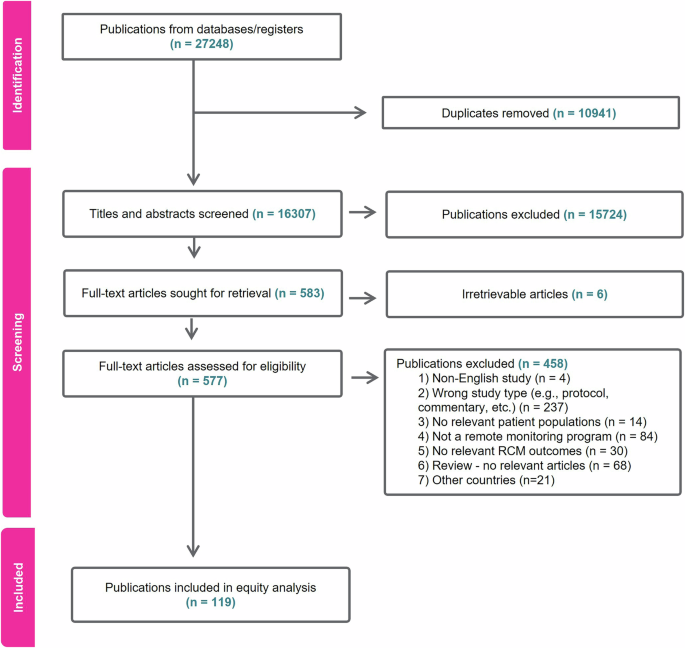
This paper represents empirical evidence that the widely held belief that RPM solutions generally advance equity and access to care for equity-deprived populations is closer to myth than reality. While it was surprising to see that almost 40% of programs in our analysis catered to older adults, the expected accessibility principles that guide AgeTech (i.e., digital technologies that support the health and wellbeing of older adults), such as digital literacy and offline capability were not areas where inclusion was prioritised. Although a main promise of RPM has been its ability to improve access to care for the most marginalised, we found that most papers did not explicitly report on the 11 equity parameters used in our analysis which represent common criteria for digital inclusion. A recently published article identified 30 high-priority digital determinants of health18. These include connectivity, device and software ability, digital literacy, health and disability status, inclusive and good practice design, socioeconomic inequalities, access and sharing policy18. As a complement, the concept of underinvested communities described by Holmes Fee et al., includes age, culturally and linguistically diverse backgrounds, urban environments, persons with chronic disease, abilities, race/ethnicity36. Underinvested communities that the priority health determinants and accompanying recommendations focus on are reflected in all 11 of our equity parameters18,36.
Overall, what matters equity-wise in the field of DHI needs to move from anecdotal references to action at individual, interpersonal, community and societal levels of the DDoH. It is also a call to action at policy and programmatic levels, where accountability and reporting mechanisms can ensure systematic monitoring of if and to what extent digital health solutions like RPM are advancing health equity. We explore the central takeaways and recommend next steps (Fig. 4) in detail below.

Panel (a) outlines three central takeaways; panel (b) outlines next steps and rationale.
In analysing RPM programs against equity parameters, we found incongruence between the current rhetoric on RPM and their theoretical or presumed potential to serve as inclusive access points to care. When equity parameters were reported, many programs in fact signaled exclusion (see Fig. 3). For example, less than half (39%) of publications were inclusive of race/ethnicity/and culture, only 9% of publications catered to rural residents, were inclusive of those with low digital literacy (8%), and far less (4%) were inclusive of those with physical or mental disabilities. Although RPM is seen as being beneficial for supporting the care needs of vulnerable patients, a rapid review on barriers of RPM use during COVID-19 highlights the converse37. RPM can inherently restrict access to its benefits through equity-related factors including ageism, cream skimming (whereby patients with complex needs are disadvantaged), geographic location, gender, racism, and socioeconomic status16,38. One salient example further exemplifying this paradox is in the domain of chronic diseases which have the most advanced RPM pathways, yet there is an under-representation in RPM implementation for minority groups39 even though they are disproportionately affected by chronic conditions (e.g., type 2 diabetes). Even when they are included, minority groups seem to experience diminished benefits and sub-optimal improvements40.
The bottom line is that while the potential for RPM is established, evidence of positive equity impact is not yet robust41. A report by Thompson et al., in the United States showed differential access to RPM favoring those living in urban settings and in census areas with lower social vulnerabilities42. This suggests that RPM programs are not being implemented with equity as a consideration for access and impact22. Without concerted and intentional effort, it is more likely that inequitable RPM solutions will remain normalized.
This equity analysis illustrated the high degree to which equitable design and access of RPM solutions are yet to be realised. The degree of missing datapoints, either from not reporting or having not been considered, hint at equity assumptions or inattention being made in the design, development, and implementation of RPM solutions. Additionally, for 10 of the 11 equity parameters, less than 40% of papers reported an inclusive practice, suggesting that not enough is currently being done and that inclusive practices are the exception, not the rule. This may also be due to under reporting as also experienced by Barcellona et al., in their framework to measure health equity in the Association of Southeast Asian Nations region43.
There is a need for technology vendors, payors, and implementation teams to critically appraise the extent to which RPM solutions are truly meeting the needs of those likely to benefit from them versus those who are most likely to be able to use them conveniently (i.e., designed for cherry picking). The dominant narrative which calls for expanding the use of remote monitoring solutions must be tempered by the realisation that prior to rapid scale, digital health equity needs to be prioritized and addressed. While the words quality, equity, and innovation have become interwoven bylines of advancements in RPM and digital technology in general, our results align with others31,44 in indicating that there is insufficient evidence to support those conclusions.
One additional factor is on how to balance equity considerations with context- or program-specific relevance. Including all 11 parameters in each study may be unrealistic and inappropriate for every context or program. For example, studies that are intentionally scoped to be narrow in nature by design do not need to address all 11 parameters before being considered equity-promoting (e.g., RPM for use in rural settings, by English speaking young adult populations). However, in these scenarios, we propound that standardized equity reporting on DHIs like RPM is necessary for understanding parameters that have been prioritised against others that are deemed to not apply. The developed checklist for reporting DHIs is a welcome step in the direction of systematic reporting, however it does not emphasize equity-related aspects45. Fundamentally, without standard guidelines and reporting tools, assumptions that are being made have the potential to inflict harm by excusing intervention-generated-inequalities.
Our findings aligns with the concern by Woolf and Vinson on how recruitment strategies are typically biased towards patients with higher cultural health capital46, i.e., those who possess the complement of relational, attitudinal, and technical skills required to maximise the benefits of clinical interactions and the care experience47. With reduced likelihood that those who experience higher rates of marginalization will have higher health capital, the risk of exclusion-by-design with RPM can easily introduce or reinforce inequities in health care access and by extension, outcomes of care. This ‘dark logic’48 state culminates in differential access to opportunities for involvement in a digitally driven health system, with fewer opportunities for equity-denied patients to both grow cultural health capital and engage meaningfully in decisions about their own care46.
Since our article search (up till March 2022), there has been increasing awareness of the need to situate and advance the goals of an equity promoting digital healthcare system31,38,49,50. While interest to address these gaps remains prominent in discourse, quantifying the nature and extent of exclusion can better inform the scale and spread of existing technologies, and inform an action plan for future initiatives. Additionally, structural and systemic factors are needed to robustly understand barriers to equitable adoption and uptake of RPM solutions33,49. In practice, this is being corroborated; in a 2023 paper on sex-and race-based disparities and opportunities in heart failure, Mastoris et al. identified several structural and systemic factors that explain the low referral and uptake of females and Black patients into RPM programs for heart failure, including socioeconomic, historical and technology-related factors38. They cited a need for multi-level interventions ingrained in policies that address the social determinants of health. This is one of the strengths of DDoH – we must evolve how RPM solutions are typically designed as standalone technological products, ignoring the broader social and policy systems with which they interact. To truly benefit a diverse range of individuals, digital health programs need to consider and be woven into the community and societal milieu33,49. This has implications for policymaking, design standards, and wireless infrastructure (society level), as well as community partnerships for planning sustainable access to technology beyond the duration of pilot studies (community level). Digital health equity will remain a myth without a closer look and commensurate response at the infrastructural and systemic contexts.
Currently, it is unclear how to operationalise digital health equity frameworks like DDoH across the RPM development pipeline. Guiding principles and frameworks exist, but there is much work to translate these into action. For example, at the design phase, human-centred or inclusive design practices have been identified as a crucial early step in promoting equitable digital health solutions51. But while equitable design considerations are necessary, they do not ensure RPM solutions are deployed as intended and in equitable ways, even if intended in theory. A mechanism for benchmarking progress is needed to drive efforts on standardized reporting and consideration of multi-level complexities and barriers that shape system-level impacts of RPM programs. This paper reinforces that standardized reporting can serve as an initial next step to facilitate benchmarking equitable RPM initiatives43. To track implementation-effectiveness progress, a validated, contextually relevant equity tool is needed. This tool would support program administrators and policymakers in systematically comparing and benchmarking RPM solutions, provide a mechanism for helping researchers understand where their RPM programs stand, and inform the development and evaluation of action plans to address equity. Our call to action for different actors in transforming how equity is considered in RPM programs is as follows:
-
Policymakers: Invest in digital health technologies in a way that incentivizes equity. This means when considering how well an RPM program performed, there needs to be a weighting placed on equity (i.e., beyond simple counts of number of patients served). Inherently, prioritizing equity in performance evaluations will help scale programs that advance equity. It will also signal policy interest that stimulates how developers and implementers respond.
-
Health service researchers and methodologists: Develop a tool to support policy makers in adopting equity as a consideration to guide investment analysis. This tool should not only include equity parameters but support the prioritization of which ones to focus on at a given point within a project’s lifecycle and as appropriate for the context. In so doing, it can facilitate monitoring and tracking of equity parameters within and across RPM programs over time. Such a tool may leverage the 11-equity parameters we have used here derived from PROGRESS-PLUS32 and DDoH33, or the health system framework to measure health equity43.
-
Technology developers: Consider the economic value of costs saved and clinical benefits when a value-based care approach informs how RPM programs are developed for a given market or population. Given growing disparities in healthcare, developers are necessary partners in rethinking the design of RPM.
-
Implementation teams: Detailed and transparent reporting that captures intervention intent, realised objectives and relevant equity indicators. Excluded or unaddressed equity parameters should be discussed within study limitations and where feasible, their projected impact on intervention-generated inequalities should be quantified.
Limitations
The benefit of conducting a rapid analytical review is the ability to answer a targeted question in a timely manner. However, this approach presents some drawbacks. First, in the absence of a consistent way to compare effectiveness while accounting for other relevant factors, our review did not consider the impact or effectiveness of the RPM programs. Second, the use of a categorical approach (i.e., yes/no/unknown) did not capture if and how RPM users are engaged throughout the stages of design, development, implementation, and evaluation of RPM solutions. And third, aside from hardware provision, there was a minimum of 24% of datapoints with an unknown status. This makes it difficult to assess whether there was a true lack of inclusion in these programs, or whether there was a failure to report them. While we chose not to extract information based on sex and gender to avoid perpetuating conflated assumptions, it will be necessary to include these parameters in future analyses as reporting standards for sex and gender become more transparent and inclusive. Furthermore, we acknowledge that a requirement to include all 11 equity parameters is not feasible for all projects and some RPM programs may still be equitable with a narrow focus. Future studies should explore patient engagement across RPM stages, address reporting gaps in excluded equity parameters, and develop a framework to track equity within RPM programs over time. Additionally, future work should focus on establishing equity-oriented reporting guidelines.
link